
Totaljobs
User Reactivation
Bringing dormant candidates back to Totaljobs with personalised email campaigns, each shaped around the known behaviours of a specific candidate group.
- Users
- Fourteen million dormant candidates, across blue- and white-collar roles
- Ownership
- Cohort model, campaign design, email design
- Role
- Senior Product Designer
The problem
Totaljobs was paying for traffic to gain applications, while it already had a vast database of dormant candidates
Fourteen million candidates had registered with Totaljobs, made a single application, and never come back. The only contact they received was job alert emails: lists of roles to apply to. That works for someone mid-search, but it gives nothing to anyone who isn’t.
Every candidate who drifted away had to be replaced with paid traffic. Bringing them back organically meant spending less on acquisition. It also gave Totaljobs a way to promote its training courses, a recent investment that was getting very little traffic. The goal wasn’t always an application.
What we found
Most dormant candidates hadn’t given up. They’d stopped needing us: some had found a role, and others were happy where they were.
Working with the Product Experience Lead, UX Research and product managers, I analysed our experience map and ran exit surveys to find out why candidates stopped returning. The answers pointed the same way. Candidates had applied for jobs, then gone quiet because some had landed the role and others had decided they were happy where they were.
That’s why job alerts weren’t working. They’re built for active job hunting, and these candidates had stopped. So we stopped treating dormant users as one group. We split them into white-collar and blue-collar candidates, then into pots by how long they’d been dormant, and each cohort had its own known behaviours.
One group many cohorts
From "how do we get dormant users back?" to "what would bring each cohort back?"
Key decisions
If candidates had stopped job hunting, the emails had to offer a reason to return that wasn’t just a job.
Using the cohorts and our prior research, I helped run a design thinking workshop with stakeholders and the development team. It generated the campaign ideas and got buy-in early. Three bets came out of it.
Sell the next step, not the next job
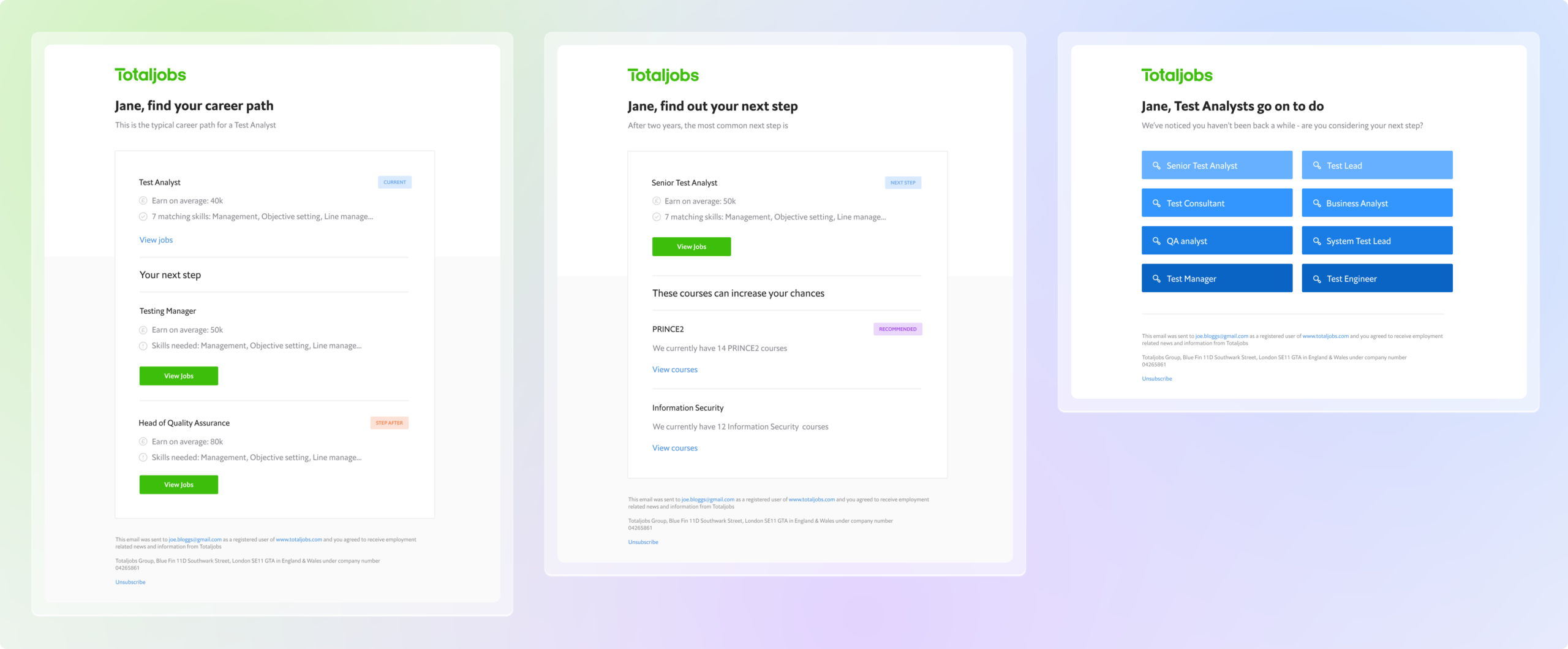
White-collar candidates dormant for over a year were likely settled, so we pitched the next rung on the ladder rather than more roles like the one they had.
Keep jobs for the newly dormant, but make them specific
Recently dormant candidates might still be open to a move, so we kept jobs but led with the details that drive a decision, such as location.
Signpost training everywhere
Across every cohort, we pointed candidates to training courses as the route to their next step, which gave the under-used courses a natural way in.
Testing and iteration
Live tests showed each cohort responding to something different, so the campaign became a sequence that adapted to how each group responded.
From wireframes to mock-ups
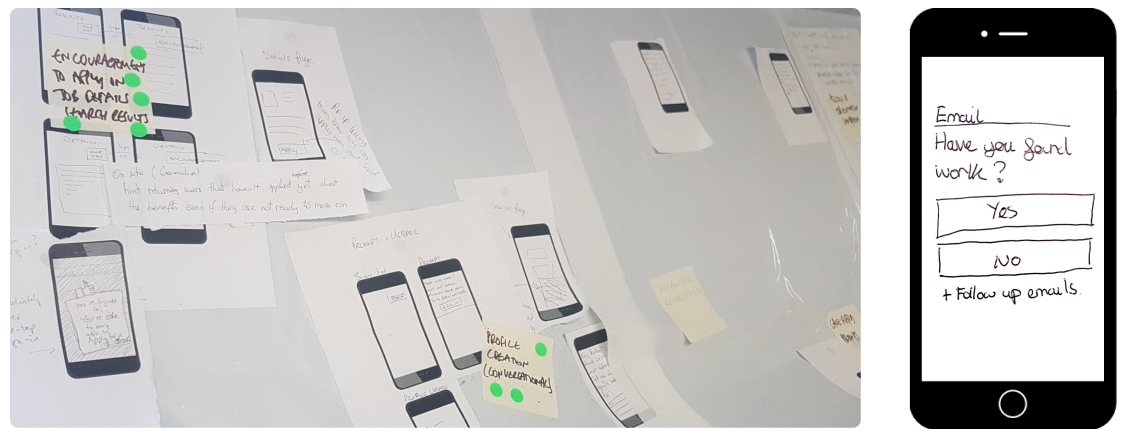
I wireframed the campaigns, presented them, and refined them into mock-ups based on the team’s feedback.
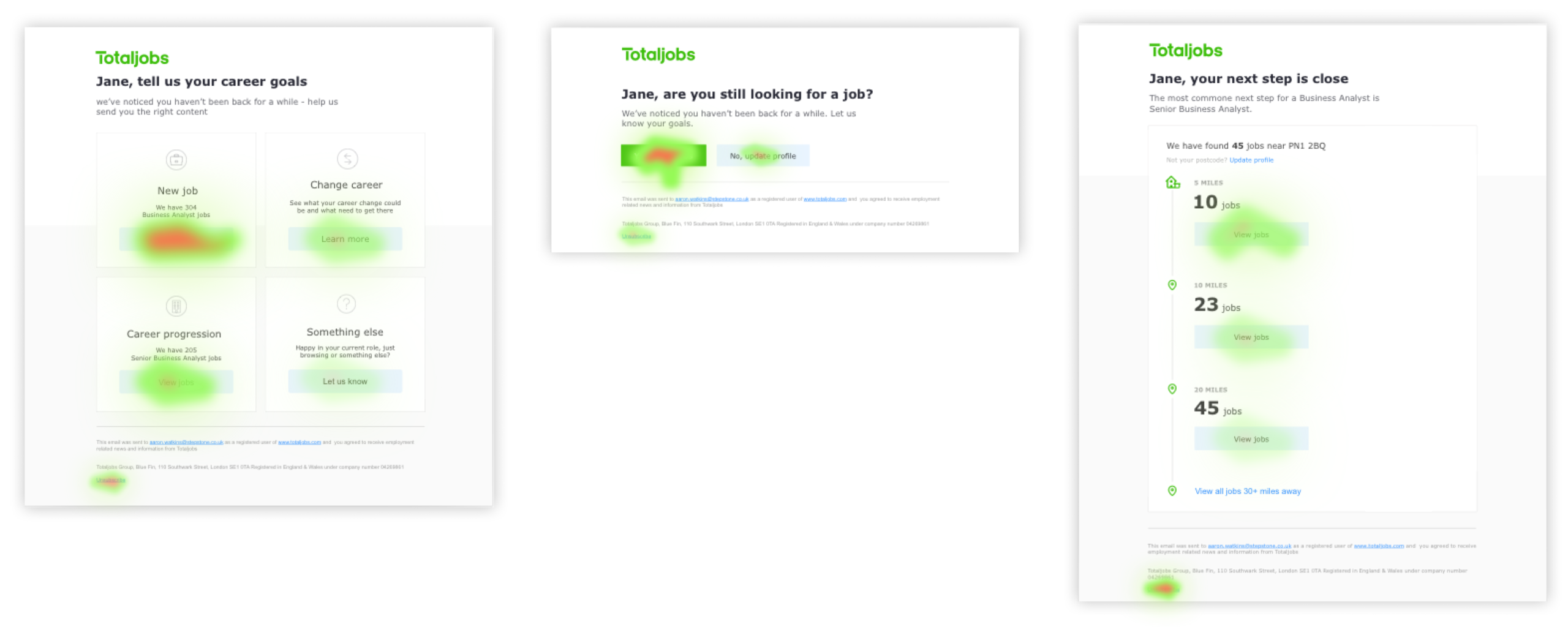
Live tests
The emails ran through Selligent, so we could see where each cohort went after returning, not just who opened what. The results backed the bets and sharpened them.
Newly dormant
They were still interested in finding jobs
Blue collar
The location of the job mattered most
White collar
Career progression emails performed best
Dormant 6+ months
Training resonated
Building the adaptive flow
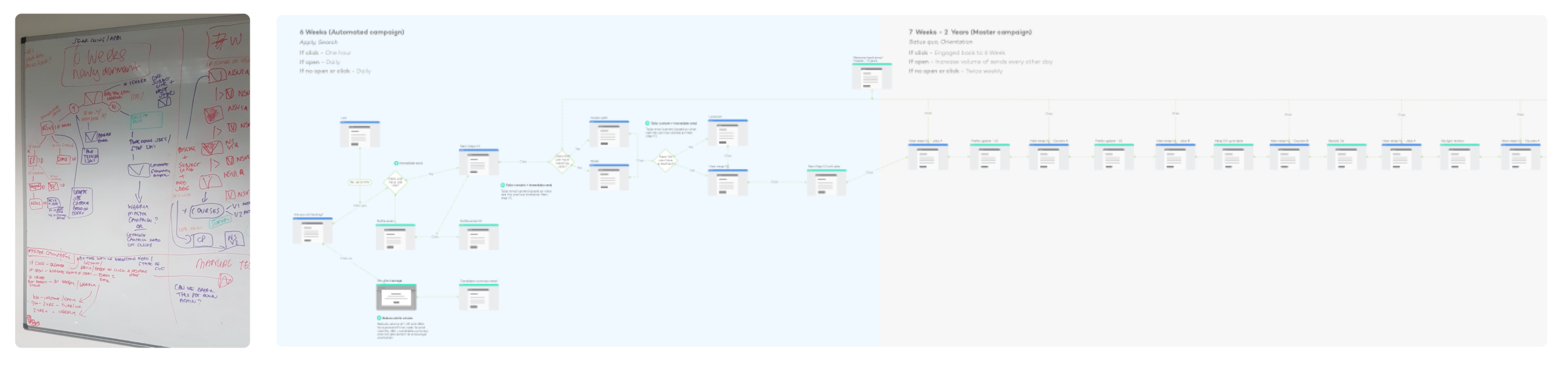
With product management, I mapped a campaign flow directly to the live test results. What each candidate received next depended on how they’d responded to the last email, so the sequence adapted rather than repeated.
Challenges
A business that thought in binaries, and a dormant pool where one wrong email could look like spam.
Binary thinking
The business thought in binary terms, active or dormant, and most candidates sat somewhere in between. I made the complexity visible: the campaign flow gave stakeholders something to see and argue with, instead of taking it on trust.
The spam risk
Emailing a dormant pool risks looking like spam, which could do more harm than good. We tested each email on a sample of the cohort first, never sent the same email twice, and waited a month before sending anything else.
Final designs
12% of dormant candidates came back, and it worked well enough that a second engineering team was put on the journey they returned to.
The campaigns were a series of personalised emails, auto-targeted at cohorts dormant from three weeks, six months and over one year, split across blue- and white-collar candidates. Each email was chosen by how the candidate had responded to the last one.
In the first 3 months, 12% of the fourteen million came back: around 1.6M candidates.
Recommendation
Elliptic
Product vision
Turned a fragmented investigation journey into a single, auditable decision path.